

Curriculum

From Clinical Foundations to Confident Practice

A complete, sequenced curriculum that takes you from the clinical and human impact of breast cancer through technique, color, application, aftercare, and the business of building a successful Areola Restoration Center.

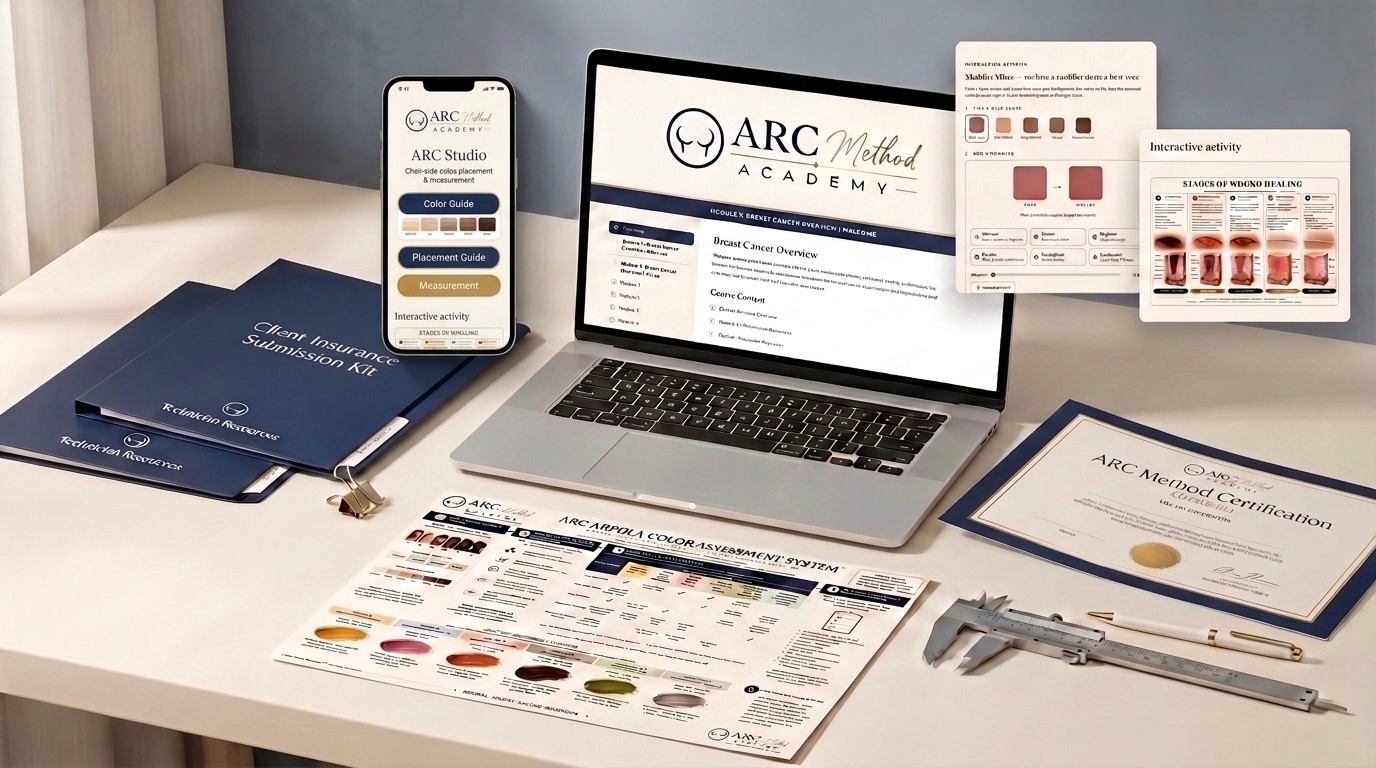
An editorial montage in the ARC navy-and-gold palette evoking the certification journey.
14
Modules
Carefully sequenced for mastery
55
Lessons
Interactive lessons and activities
300+
Pages
Of clinical reference and guidance
40+
Resources
Downloadable tools and templates

Inside the learning experience

Built for Providers. Designed for Results.

Every element of the ARC Method Academy curriculum is designed to give you the confidence, competence, and clinical judgment to excel.

Clinical Education

Deep understanding of breast cancer, reconstruction, wound healing, scar assessment, and patient care.

Technique Mastery

Pigment science, color theory, mapping, application techniques, and advanced areola restoration.

Interactive Training

Engaging video instruction, knowledge checks, clinical exercises, and real-world case applications.

Certification

Competency assessments that lead to ARC Method Certification and professional credentialing.

A Curriculum You Can Trust

Developed in collaboration with surgeons and medical experts, the ARC Method Academy sets the standard for areola restoration education. Request Information

Module by module

Inside the ARC Method™ Curriculum

Explore the 14 modules that guide you from the clinical foundations of breast cancer through consultation, color science, application technique, aftercare, documentation, and practice development. Each module combines expert instruction, interactive learning, downloadable clinical resources, and knowledge checks designed to build confidence step-by-step.

Unlike traditional PMU training, the ARC Method™ begins with the patient, not the procedure. Every module builds on the clinical knowledge, decision-making, and technical skills required for restorative areola tattooing.

  1. Module 01

    Breast Cancer Overview

    Understand the clinical, emotional, and social impact of breast cancer, the evolution of treatment, and the patient journey that every restorative practitioner should understand before beginning treatment.

    • Breast cancer incidence and survival
    • Staging and treatment pathways
    • Emotional and identity impact
    • Intimacy, family, and cultural considerations
    • Equity and access to care
  2. Module 02

    The Breast Cancer Care Team

    Understand the role of every member of the breast cancer team, from surgeons and oncologists to reconstructive specialists and support professionals, and learn where the restorative practitioner contributes within the continuum of care.

  3. Module 03

    Clinical Foundations: Cancer, Reconstruction & Tissue Response

    Build the clinical foundation for restorative practice by understanding breast cancer staging, reconstructive procedures, tissue healing, and how these factors influence treatment planning and outcomes.

    • Staging and diagnosis
    • Surgical outcomes and reconstruction
    • Nipple reconstruction
    • Wound healing and scar tissue
  4. Module 04

    Consultation & Client Assessment

    Learn how to conduct a thorough, compassionate consultation by evaluating tissue quality, setting realistic expectations, identifying contraindications, and creating an individualized treatment plan.

  5. Module 05

    Clinical Environment, Safety & Workflow

    Create a safe, organized, and reputable clinical environment — from room preparation and infection control to procedural workflow, documentation, and patient comfort.

    • Room setup
    • Sterilization versus disinfection
    • Hygiene and bloodborne-pathogen standards
    • The mixing station
    • Pain management
    • Procedural flow
  6. Module 06

    Choosing & Using Pigments in Practice

    Develop a systematic approach to pigment selection by understanding color theory, pigment composition, safety considerations, and the disciplined palette that forms the foundation of the ARC Method™.

    • Building a limited palette
    • Pigment quality and safety
    • Pigment chemistry
    • The fifteen-color working palette
  7. Module 07

    Outlining & Shape Creation (Areola Mapping)

    Learn to create natural-looking areola design through accurate mapping, proportional placement, and outlining techniques for both unilateral and bilateral restoration.

    • Mapping and proportion
    • Outlining methods: bilateral and unilateral
  8. Module 08

    Color Theory & Areola Color Matching

    Develop the skills to assess skin tone, undertones, tissue characteristics, and pigment behavior to create natural, individualized color formulas.

    • Color assessment and the Fitzpatrick scale
    • Undertones and pigment selection
    • Building custom color formulas
  9. Module 09

    Areola Application Technique

    Master the techniques used to create realistic, three-dimensional areola — layering, shading, texture, dimension, and detail.

    • Motion and shading
    • Nipple outlining and shadow
    • Creating dimension
    • Texture and creases
    • Final detailing
  10. Module 10

    Client Aftercare & Healing

    Prepare clients for a successful healing experience with evidence-based aftercare instructions, healing expectations, follow-up recommendations, and long-term care guidance.

  11. Module 11

    Complications, Client Communication & Clinical Follow-up

    Recognize and manage common complications, communicate confidently with patients and clients, document clinical findings, and provide appropriate follow-up to support the best possible outcomes.

    • Complications and troubleshooting
    • Client communication and documentation
  12. Module 12

    Insurance Documentation, Communication & Coding

    Learn how to prepare documentation, understand coding principles, and communicate effectively with insurance providers to help support patient access to restorative care.

    • ICD coding
    • Insurance documentation and client communication
  13. Module 13

    Networking, Marketing & Business Growth

    Learn practical strategies for building a successful restorative practice through physician relationships, ethical marketing, professional networking, and efficient business systems.

    • Building referral relationships
    • Marketing a restorative practice
    • Digital tools and workflow
    • Professional networking and practice growth strategies
  14. Module 14

    Clinical Case Studies & Outcome Evaluation

    Apply everything you've learned by reviewing real clinical cases, evaluating outcomes, identifying treatment decisions, and recognizing opportunities for improvement.

    • Clinical case evaluation
    • Outcome assessment
    • Treatment decision-making
    • Before-and-after analysis

Included with your enrollment

A working resource library

Beyond the modules, enrolled practitioners get a full resource shelf for practice — downloadable clinical tools you use every day, plus libraries built for client support, clinical reading, and technician sourcing.

Forms and consent templates

Client intake, consent, and aftercare forms, ready to use in your practice.

Reference appendix

A quick-reference appendix covering the clinical and technical essentials.

Glossary of terms

Plain-language definitions for the clinical and pigment terms used throughout.

Contraindications & precautions

A working reference for contraindications, precautions, and when to clear or refer.

Resources by state

Local support directories you can share with clients, organized by state.

Clinical library

Studies, white papers, and clinical updates for continuing education.

National library

Vetted national survivor resources — products and organizations that serve women across the country.

Technician resource library

Suppliers and products for practice — pigments, machines, supplies, and more — buy genuine and buy direct.

Experience the Complete ARC Method™ Certification

Explore every step of the certification experience from enrollment through clinical mastery.